
Porcelain veneers are one of the more well-known cosmetic dental treatments available, but how they actually work is not always clearly explained. If you have heard the term and wondered what veneers involve and whether they might be right for you this guide covers the key things to understand.
Veneers are a minimally invasive way to change the appearance of teeth that are chipped, stained, uneven, or slightly misaligned. They are custom-made and designed to blend naturally with the rest of your smile. For many patients in Lower Hutt and beyond, they form part of a broader cosmetic dental plan.
What Is a Porcelain Veneer?
A porcelain veneer is a thin shell of dental-grade ceramic material that is bonded to the front surface of a tooth. It is custom-made to fit the shape, size, and colour that best suits your smile.
Unlike a dental crown in Lower Hutt, which covers the entire tooth, a veneer covers only the visible front surface. This means less natural tooth structure needs to be removed during preparation making it a more conservative option for improving the appearance of teeth that are otherwise healthy.
Porcelain is used because it closely mimics the light-reflecting properties of natural tooth enamel, giving veneers a realistic and natural appearance.
What Can Porcelain Veneers Address?
Veneers are primarily a cosmetic treatment. They can be used to improve the appearance of teeth that have long-term staining or discolouration that has not responded to whitening, chips or cracks that affect the appearance of the tooth, an irregular or uneven shape, minor spacing or gaps between teeth, slight misalignment where orthodontic treatment is not preferred, and teeth that appear short or worn down.
It is important to note that veneers are a cosmetic solution rather than a structural one. If a tooth has significant decay, damage, or structural weakness, a crown or other restorative treatment may be more appropriate. Your dentist will assess this during your consultation.
Veneers are not suitable for every situation.
Your dentist will carry out a thorough assessment to determine whether porcelain veneers are appropriate for your teeth and oral health. A personalised consultation will help clarify your options.
How Are Porcelain Veneers Made and Fitted?
Step 1 – Consultation and Planning
The process begins with a consultation where your dentist assesses your teeth and discusses what you would like to achieve. Photographs, impressions, or digital scans may be taken to plan the treatment. This is also the stage to discuss the desired shape, size, and shade of your veneers.
Step 2 Tooth Preparation
A small amount of enamel is removed from the front surface of each tooth receiving a veneer typically less than a millimetre. This creates space for the veneer to sit flush with the surrounding teeth without appearing bulky. Local anaesthetic is used to keep you comfortable. A temporary veneer is usually placed while the long-term one is being made. Suitability, timelines, risks, costs, and outcomes vary and will be discussed during consultation.
Step 3 Fabrication
Impressions or digital scans of your prepared teeth are sent to a dental laboratory where your custom veneers are crafted. The shade and shape will have been determined in advance to ensure the result matches your natural teeth and meets your expectations.
Step 4 Bonding
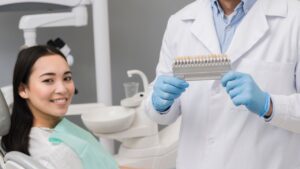
When your veneers are ready, they are carefully bonded to the front of each prepared tooth using a strong dental adhesive. Your dentist will check the fit, colour, and bite before permanently cementing them in place. Any final adjustments are made at this stage.
What Should You Expect After Getting Veneers?
Many patients adjust to their veneers within a short time, though the settling-in period varies between individuals. Some mild sensitivity is normal in the days following preparation, as a small amount of enamel has been removed. This generally settles on its own.
Your dentist in Lower Hutt will advise you on any adjustments to your routine during the settling-in period.
How Do You Care for Porcelain Veneers?
Caring for veneers is straightforward and follows the same principles as caring for natural teeth. Brush twice daily with a soft-bristled toothbrush and non-abrasive toothpaste. Floss daily, being gentle around the veneer margins.
Avoid biting directly on very hard foods such as ice or hard sweets. If you grind your teeth at night, let your dentist know a night guard may be recommended to protect your veneers. Attend regular dental check-ups so your dentist can monitor the condition of your veneers.
With good care and regular dental visits, porcelain veneers may last many years. Individual outcomes vary depending on oral hygiene habits, lifestyle factors, and the location of the veneers in the mouth.
Porcelain Veneers in Lower Hutt
If you are considering porcelain veneers in Lower Hutt, a consultation with the team at Hutt Dental Hub is a good place to start. The team can assess whether veneers are suitable for your teeth and discuss your cosmetic goals in the context of your overall oral health.
Frequently Asked Questions
Are porcelain veneers long-term?
Veneers are considered an irreversible treatment because a small amount of enamel is removed during preparation that cannot be replaced. The veneers themselves are not long-term in the sense that they may need to be replaced at some point after many years of wear. If you are considering veneers, it is important to understand this commitment and discuss it fully with your dentist beforehand. Suitability, timelines, risks, costs, and outcomes vary and will be discussed during consultation.
Do veneers look natural?
Porcelain veneers are designed to closely replicate the appearance of natural tooth enamel. When made well and properly shade-matched, veneers are designed to blend naturally with the rest of your smile. Results will vary between individuals. Results depend on the skill of the dental team and the quality of the laboratory fabricating the veneers. Your dentist will take care to ensure the shape and colour suit your face and existing smile.
Can veneers be used to fix crooked teeth?
Veneers can improve the appearance of mildly misaligned teeth by altering their shape and creating a more uniform look. However, they do not move teeth in the way that orthodontic treatment does. For more significant alignment issues, clear aligners or braces may be a more appropriate first step. Your dentist can advise on the best approach for your specific situation.
How many veneers do I need?
The number of veneers depends on your goals and which teeth are visible when you smile. Some patients choose veneers for just one or two teeth, while others opt for a full set covering the upper front teeth for a more comprehensive change. Your dentist will discuss the options and help you decide what makes sense for your smile and budget.
Conclusion
Porcelain veneers offer a way to make meaningful cosmetic improvements to teeth that are otherwise healthy. They are versatile, natural-looking, and when well cared for, can last for many years.
As with all cosmetic dental treatments, the right outcome depends on careful planning, a skilled dental team, and realistic expectations. A consultation is the best way to find out whether veneers are a good fit for your smile and your goals.
If you are based in Lower Hutt and would like to find out more, the team at Hutt Dental Hub is here to help.
Sources:
- https://www.healthline.com/health/dental-veneers
- https://my.clevelandclinic.org/health/treatments/23522-dental-veneers
- https://pmc.ncbi.nlm.nih.gov/articles/PMC6311473/
- https://www.researchgate.net/publication/344578533_A_Detailed_Overview_on_Veneers_-Diagnostic_and_Clinical_Considerations

Hutt Dental Hub is a dental clinic serving the Lower Hutt community. Our dentist in Lower Hutt provides a wide range of services including general dentistry, dental implants, orthodontics, emergency appointments, and dental sedation. Using advanced 3D digital technology, we deliver accurate, patient-focused care. As NZDA members, our team is committed to ongoing professional development and best practice.